
Marshall Glickman is the former President of the NBA’s Portland Trail Blazers and its affiliated companies, including Oregon Arena Corporation (now Portland Arena Management), where he oversaw the development of the $262m Rose Quarter district, including the Rose Garden (now Moda Center), a 21,000-seat multi-purpose indoor arena.
He is also the former Founder, Chairman & CEO of Portland Family Entertainment, which owned and operated several minor league sports clubs, including the Portland Timbers (who now play Major League Soccer), and renovated PGE Park (now Providence Park), a 21,000-seat multi-purpose outdoor stadium which has since been converted to a soccer-only stadium for the Timbers.
Early in his career, Marshall spend two years with the National Basketball Association, where he was Broadcasting Coordinator and Director of Media Sales (NBA Properties).
Marshall began his career in Los Angeles, syndicating jazz radio programs. Later, Marshall sold cable and pay television subscriptions door to door, before starting his sports business career with the Trail Blazers.
Marshall founded G2 Strategic in September, 2004, after living for two years in Barcelona, Spain, as a full-time consultant to Euroleague Basketball. He is one of the few sports business executives who has been intimately involved with both of the world’s leading professional basketball leagues and has hands-on experience on both sides of the Atlantic Ocean.
I was keen to find out what soul means to someone with such a rich and multi-cultural business heritage:
Soul means having empathy for people and the situation that we find ourselves in. Of course, for me, it’s a certain kind of music that I happen to like. I must mention that as well, because you know, soul music comes from inside. That’s the beauty of it, which originally came from rhythm and blues, from black music in the South when people were enslaved; that music had to come from inside because they didn’t have the technology and sometimes even the instruments, but they had their voice.
Soul means a lot of different things. But certainly this is a time that we need people and companies to show their soul.
How does the idea of soul relate to business?
If you’re in business, it means that you must have customers, right? There’s no business that I can think of that doesn’t require other people to want to buy your service or your product, or some form of relationship with the business. And so, I think in this era people care a lot about values and they care about the behaviour of who they’re doing business with. And whether those behaviours are aligned with their values.
So when we think about the soul of a business, it doesn’t mean everybody has to have the same values, but I think more and more people want to align themselves and do business with companies that put customers first, and people first, and really focus more on service than necessarily on product. Because a lot of people make good products, not everybody gives good service.
It’s how does a company relates to its community, its stakeholders. And are they doing that with authenticity, or is it fake? Is it PR firms spinning an image, or is it really coming from inside?
I think the companies that are more authentic and transparent, are in this time far more successful. And I think that’s going to be more and more of the case. This matters a lot to Gen-Z and I think the generation behind Gen-Z even more. People are less connected to material things and more connected to experience. And so, when you do business with somebody, it’s not just what it is that you’re buying from them, but it’s how you interact with them. Is it a positive experience?
Can you give us a good example of soul in business?
I’m blown away by Major League Soccer, which launched almost 25 years ago. The basic principle of the business proposition was: “Hey, soccer is the number one youth participation sport in the United States. Everybody’s kid plays soccer. Even my kid played soccer. And my kid also played baseball, football, and was an alpine ski racer. But soccer, you throw the ball in, run around…there’s not much to it.” So, it’s an immensely popular sport at the youth level in the United States. It’s big. So, some genius said: “Well, this is easy, we’ll start a professional league and we’ll just go to the parents of these kids and they’ll buy tickets and watch games on TV because their kids play the sport.”
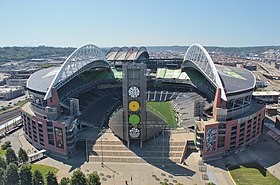
Photo: Creative Commons License: https://fr.wikipedia.org/wiki/Coupe_de_la_Major_League_Soccer_2019
So, for the first 10 or so years, that was the idea. It didn’t work out so well, as they lost tens of millions. At one time, there were only three or four owners of all the teams! At one point, Phil Anschutz owned four five different teams in the same league. I believe there were championship games where they were playing each other’s teams, so Phil Anschutz could go into either locker room after the game and pour champagne over people.
So that was MLS’s business model. They then hired Don Garber from the NFL. And he came in and completely overhauled everything and changed the mentality and started implementing a new strategy, which was about culture. As I see it, MLS has successfully built a unique culture that is anchored by the “alt” crowd. If you know what ‘Alt Rock’ is, it’s alternative, not mainstream. So, they didn’t try to pick off NBA fans, which is much more upscale. And they didn’t try to compete with America’s pastime, baseball, which is different kinds of fans. And they didn’t go to the hardcore American football people. Of course, there is overlap, but MLS has created their own identity. They have created a whole cultural phenomenon that is rooted in diversity, they have been super-sophisticated with data and they have created an atmosphere that mimics the best of European football.
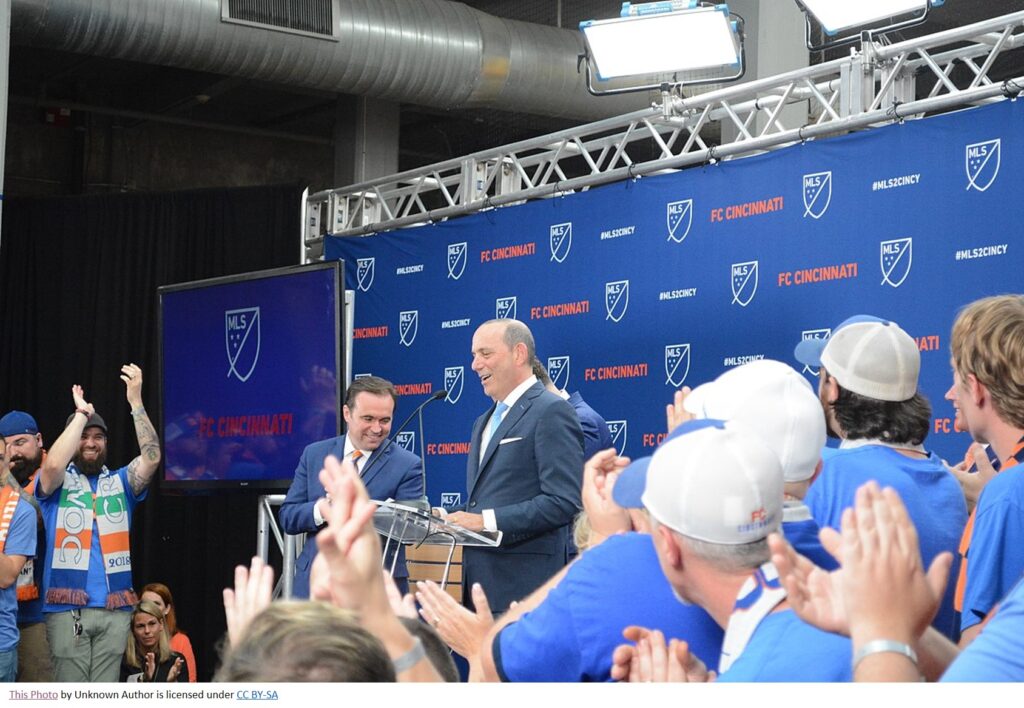
.jpg#/media/File:MLS2Cincy_announcement_-_John_Cranley,_Don_Garber_(42444289001).jpg)
Two years ago, I led a group of about 20 EuroLeague club and league executives on a tour of New York City venues, as well as meetings with the major venues, leagues and clubs. We went to NFL, MLS, NBA and NHL games. So, we go walking into MLS headquarters, which is in Midtown Manhattan. And I could not believe what I saw. As the elevator opened, I saw a sea of diversity. There were no closed offices. I saw a collaborative environment. No ‘behind closed doors.’ Occasionally, maybe you must have a private conversation, so we have some phone booths over there for that, but generally working in an open, environment encourages people to work together. I’ve never seen anything like this in my life. I saw Asian people, Indian people, Chinese, Japanese, Pakistanis, middle Eastern people, British people, French people, German people, Spanish people, Italian people. The whole range of human beings.
It really struck me. So, I started having a conversation with one of their senior executives and I said, ‘You know, I’m blown away by this. It’s incredible. And they said: “Well, you know, the point is that the people working in this office reflect the marketplace that we’re pursuing.”
And I thought, man, that’s what soul is, isn’t it? The people in there have this incredible passion that is to some extent driven by the ‘beautiful game’, but it’s even more about the culture around the game. Major League Soccer stands for something meaningful for a lot of people, which is:
“We celebrate and embrace the diversity of human beings. And we are going to have a place that reflects that diversity, that really is a model of that.”

And I thought, man, that’s what soul is, isn’t it? The people in there have this incredible passion that is to some extent driven by the ‘beautiful game,’ but more about the culture around the game. Major League Soccer stands for something meaningful for a lot of people, which is ‘we celebrate and embrace the diversity of human beings. And we are going to have a place that reflects that diversity, that really is a model of that.’
Walking around New York city or London you’ve got this incredible melting pot. You’ve got this melting pot of people from all over the world. It’s unbelievable. And so, it was heartening to see a similar melting pot inside the offices of MLS.
Since Garber came MLS has made this cultural transition, their numbers are growing steadily. Many of the clubs are profitable, but more importantly, the value of the clubs is something like a ten-fold increase in valuation…people that bought in for $30 million can sell them now for over $300 million. So, MLS cultural diversity has translated to the bottom line. Why? Because a lot of companies want to align themselves with those values. That was the point I was making earlier. MLS has limited television exposure. I mean, they’re on TV, but it’s not huge. They get relatively small ratings on TV. In the States, if you are a hardcore soccer fan, you can watch EPL, Bundesliga, Serie-A and LaLiga.
But that’s not why people are watching. That’s not why people are going to the games. That’s not why the stadiums are full. They’re full because it’s a social gathering of like-minded people who want to be in a diverse environment. It’s a beautiful thing. The football will come, but they have set the table for the future quite well.

This interview is one of 60 I’ve completed this year with a mix of past customers and other leading industry figures. Do connect with me on Linked In or get in touch via our website if you’d like to know more about the research findings and/or explore how to drive your business forward…with soul.
You can book me to speak personally at an event or meeting, online or (circumstances allowing) face to face.